

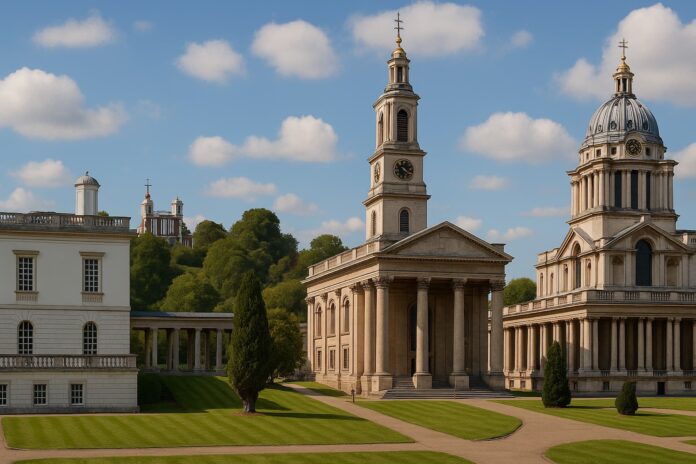
Greenwich, along the River Thames, is one of London’s most historically rich districts. Known for its maritime heritage, stunning architecture, and scientific landmarks, Greenwich offers visitors a journey through royal history and global influence. Designated a UNESCO World Heritage Site in 1997, it’s a treasure trove for history enthusiasts and cultural explorers alike.
1. Queen’s House: A Masterpiece of Classical Elegance
Designed by Inigo Jones in the early 17th century, the Queen’s House was commissioned by Anne of Denmark. It is celebrated as England’s first classical building, marking a shift from Tudor to Palladian styles. Highlights include the Tulip Stairs, Britain’s first geometric self-supporting spiral staircase. Now part of the National Maritime Museum, it displays royal portraits and fine art, embodying Renaissance ideals of symmetry and order.
Tip: Observe the precise symmetry; it’s a hallmark of Renaissance architectural beauty.
2. Painted Hall, Old Royal Naval College: Britain’s ‘Sistine Chapel’
The Painted Hall, completed in 1705, is a Baroque masterpiece by Sir James Thornhill, designed by Sir Christopher Wren and Nicholas Hawksmoor. Its murals celebrate Britain’s naval power, monarchy, and mythology, earning it the nickname “Britain’s Sistine Chapel.” Visitors can admire the grand ceiling and walls or enjoy the unique dining experience beneath these historic murals.
Tip: Lie on the special viewing benches for a full perspective of the magnificent ceiling.
3. Royal Observatory: The Home of Greenwich Mean Time
Founded in 1675 by King Charles II and designed by Christopher Wren, the Royal Observatory is the historic home of the Prime Meridian Line, dividing the eastern and western hemispheres. It features the Great Equatorial Telescope and John Harrison’s marine chronometers, which revolutionized maritime navigation.
Tip: Stand with one foot in the eastern hemisphere and one in the western for a memorable photo.
4. Cutty Sark: A Victorian Maritime Icon
Launched in 1869, the Cutty Sark was one of the fastest tea clippers ever built. Moored in Greenwich, it’s the last surviving tea clipper in the world. The ship showcases Victorian craftsmanship, from its iron-framed wooden hull to its sleek lines, representing Britain’s maritime dominance. Visitors can explore its decks, cabins, and cargo holds.
Tip: Walk beneath the ship’s hull for a rare engineering perspective.
5. UNESCO World Heritage Site: Protecting Maritime Greenwich
Maritime Greenwich was designated a UNESCO World Heritage Site in 1997, highlighting its royal, scientific, and naval landmarks. This status ensures preservation of the Queen’s House, Royal Observatory, Old Royal Naval College, and surrounding historical structures. Greenwich stands as a living museum of Britain’s architectural and cultural legacy.
Tip: Take your time to explore the entire area; it’s like walking through history.
FAQs
Q1: Why is the Queen’s House historically important?
A1: It’s England’s first classical building, introducing Renaissance symmetry to British architecture.
Q2: Can visitors stand on the Prime Meridian Line?
A2: Yes, it allows a unique experience straddling the eastern and western hemispheres.
Q3: What is special about the Cutty Sark?
A3: It’s the world’s last surviving tea clipper, showcasing Victorian maritime innovation.
Conclusion:
Greenwich is a must-visit for history lovers, offering a unique blend of royal elegance, maritime heritage, and scientific milestones. From the Queen’s House to the Prime Meridian, each landmark tells a fascinating story, cementing Greenwich as a global cultural treasure.
 Grace Zoya